

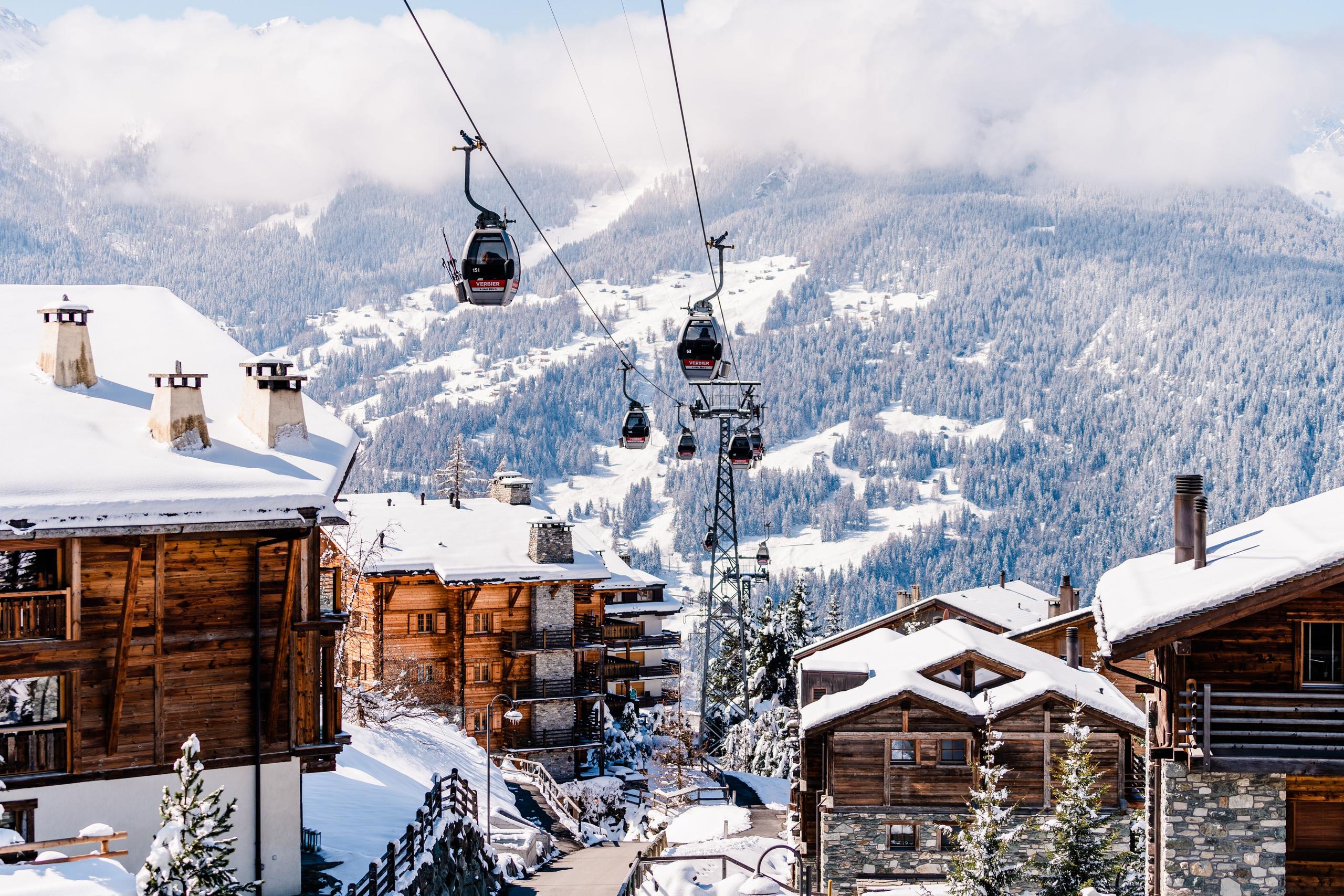
The history of Verbier: from an alpine hamlet to an Alpine legend
Perched at an altitude of 1,500 metres on a sun-drenched terrace in the Val de Bagnes, Verbier is one of Switzerland’s most renowned resorts and a global benchmark for skiing and the Alpine way of life. As the gateway to the 4 Vallées ski area — the country’s largest interconnected ski area — it combines an international reputation, a cosmopolitan atmosphere and the unspoilt charm of a mountain village with its slate-roofed chalets. A prestigious year-round destination, Verbier appeals equally to guests seeking something exceptional and to property owners looking for a rare gem in the Alps.
Origins: a plateau of mountain pastures in the Val de Bagnes
Before becoming a resort, Verbier was one of the eight districts of the municipality of Bagnes, first mentioned as far back as the Middle Ages — a castle is recorded there as early as 1287. For centuries, life there revolved around mountain farming and summer grazing: families from the valley would take their herds up to these sunny, south-facing mountain pastures. Until the early 20th century, the village had only a handful of year-round residents, and it is said that ‘until 1920, Verbier barely existed’.
Everything was, however, about to change, driven by a rare combination of factors: a sun-drenched plateau, ideal slopes and the vision of a few pioneers.
The early days of tourism (1927–1949)
Tourism began to take off in Verbier during the interwar period. The first hotel opened in 1927, followed in 1937 by the establishment of the development company, tasked with organising the resort’s growth. From that time onwards, the pressure of tourism began to be felt: the first visitor’s tax dates from 1937, the first town-planning regulations from 1939, and the first road suitable for motor vehicles from 1949.
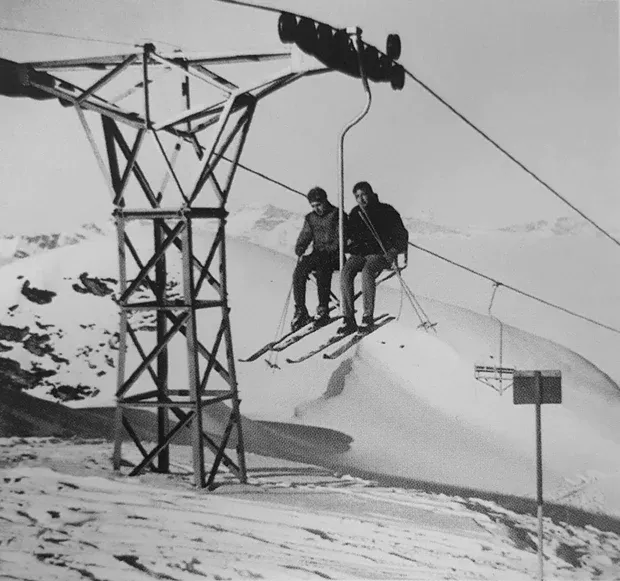
In 1946, Verbier even broke new ground by inaugurating the ‘funiluge’, the picturesque forerunner of ski lifts: passengers were hauled 200 metres up the slope, seated in a sledge pulled by a cable. The skiing adventure could begin.
1950: the Médran chairlift – a milestone
The year 1950 marked the resort’s real beginning. Five members of the development company — Maurice Besson, Léonce Gailland, Gaston Meilland, Hermann Fellay and Gilbert Roux — embarked on a daring venture: to equip Verbier with modern ski lifts. They entrusted the project to Rodolphe Tissières, a local from the valley who would go on to become a key figure in its development.
A heroic endeavour
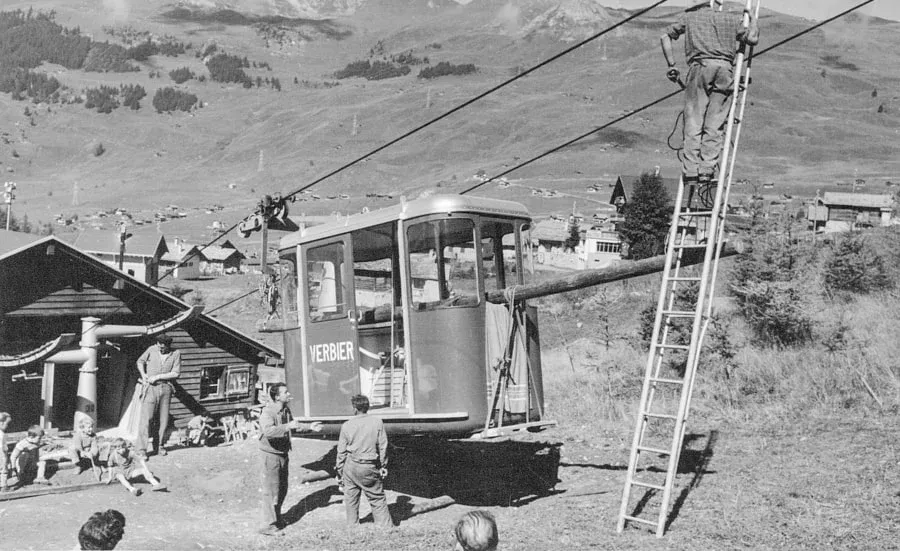
The construction was nothing short of a feat. With no road, a local resident, Joseph Fellay, known as ‘des plaques’, would break trail through the snow every morning — sometimes up to his waist — to guide the workers and carry the heavy components on their backs, using ladders. The cable itself was hoisted by hand. Despite these extreme conditions, the Médran gondola lift was inaugurated on 23 December 1950 — though not without a memorable breakdown on opening day, when the power station cut off the electricity, concerned about the overload! Often regarded as Switzerland’s first detachable single-cable gondola lift, it revolutionised skiing and truly launched the resort.
Photo – https://verbier4vallees.ch/fr/a-propos-de-nous/un-peu-d-histoire
Expansion: from a single resort to a legendary ski area (1950–1983)
It was an instant success. As early as 1952, a ski lift was added to the facilities at the Tête des Ruinettes, and the development of the ski area gathered pace. In 1955, the sun-drenched Savoleyres sector was developed; the Verbier–Les Attelas–Lac des Vaux route was built under the leadership of Rodolphe Tissières. In 1960, the merger of the companies gave rise to Téléverbier, which would drive the ski area’s continued expansion.
The following decades saw the resort grow at a steady pace: the gondola linking Le Châble to Verbier was completed in 1975, opening up the resort once and for all. Then came the crowning moment.
1983: Mont-Fort and the birth of the 4 Vallées
In 1983, the opening of the Mont-Fort cable car, at 3,330 metres, took the ski area beyond the boundaries of the Val de Bagnes and linked it to neighbouring resorts. This marked the birth of the 4 Vallées, now Switzerland’s largest interconnected ski area. From its summit, the panorama takes in the Matterhorn, the Grand Combin and Mont Blanc. Verbier had just conquered the Alpine skies.
Verbier, the freeride capital of the world
If Verbier is so renowned today, it is also thanks to a discipline that has forged its legend: freeriding. The resort’s exceptional terrain — the slopes of Mont-Gelé and Mont-Fort, and the Tortin mogul field — has made it a mecca for the most daring skiers and snowboarders.
Since 1996, the resort has hosted the flagship event of the Freeride World Tour, the Verbier Xtreme, on the north face of the Bec des Rosses. This legendary event, where the world’s best riders hurtle down a vertiginous slope, has firmly cemented Verbier’s place in the imagination of mountain enthusiasts and contributed to its international reputation.
Verbier today: a global reputation
At the dawn of the 21st century, Verbier combines its mountain heritage with its status as a world-renowned, prestigious destination. The resort has managed to preserve the charm of an authentic Alpine village — chalets with slate roofs, bustling narrow streets — whilst attracting a discerning international clientele, drawn by the quality of its ski area, its gastronomic and cultural scene, and its way of life.
Since 2021, Verbier has been part of the new municipality of Val de Bagnes, formed by the merger of Bagnes and Vollèges. From a forgotten alpine hamlet to an alpine icon, the resort continues to write its history.
At CosyHome, we are proud to look after the residences that give Verbier its prestige, carrying on the pioneering spirit that built this exceptional destination. Discover our second-home management services